Interoperability Is Becoming a Manufacturing Imperative in Africa
African manufacturers are investing in automation, enterprise software, connected equipment, analytics and AI. But as industrial technology becomes more sophisticated, another challenge is becoming harder to ignore: making different systems work together. Interoperability is becoming a strategic requirement for manufacturers that want to modernise without continuously replacing existing infrastructure or becoming dependent on a single technology ecosystem.
Manufacturing environments are becoming increasingly digital.
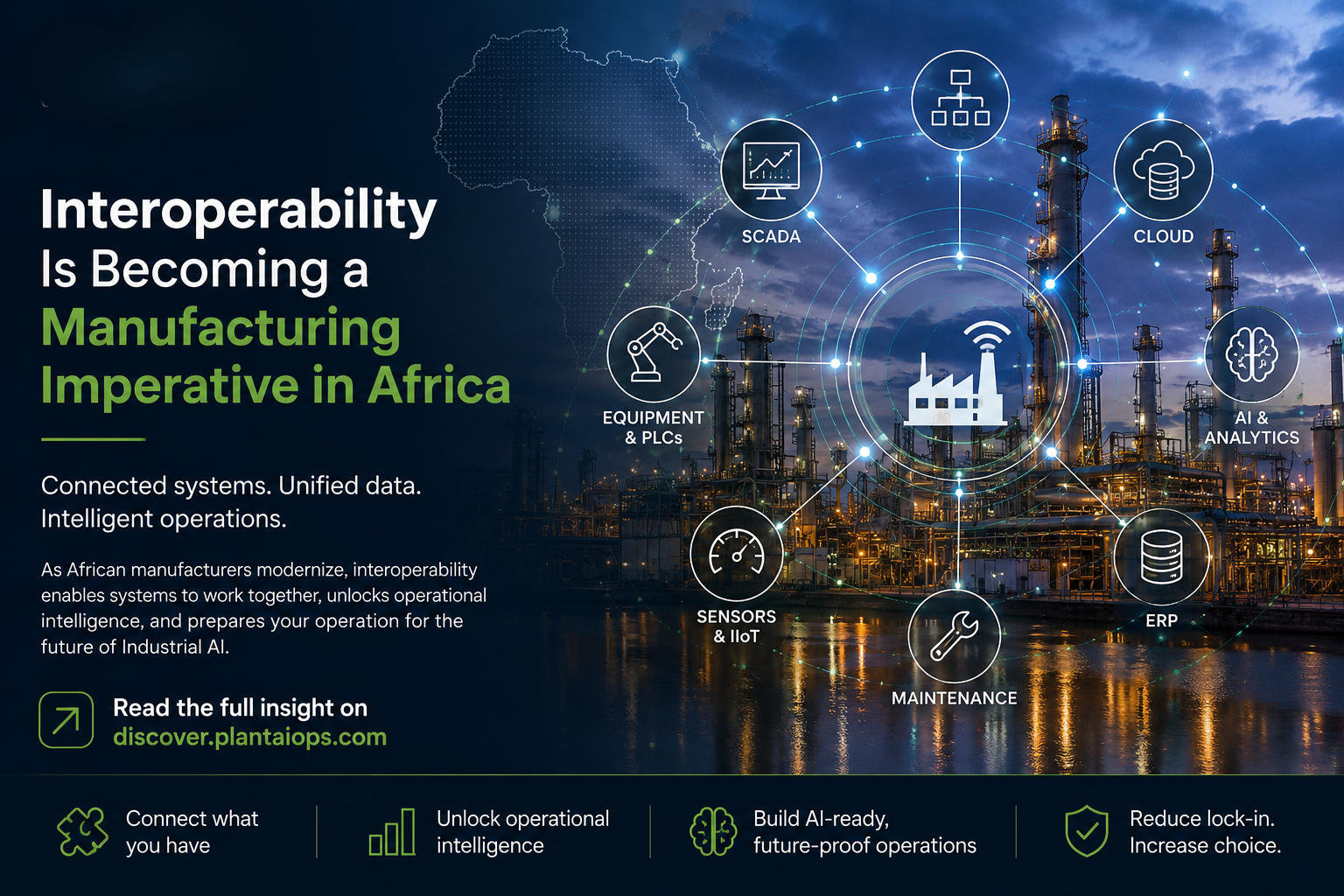
A single facility may now contain PLCs, SCADA systems, MES platforms, ERP software, maintenance applications, energy systems, sensors, cloud platforms and AI tools—often supplied by different vendors and introduced at different points in the plant's history.
Each system may perform its role effectively.
The challenge is what happens between them.
When systems cannot exchange information effectively, manufacturers can end up with fragmented data, manual processes, limited visibility and expensive integration projects.
For African manufacturers, this challenge is particularly important.
Industrial transformation across the continent will often happen incrementally. Existing equipment will continue operating alongside new technologies. Plants will modernise in stages rather than replacing their entire technology stack at once.
This makes interoperability more than a technical consideration.
It becomes a strategic capability.
The Factory Is No Longer a Collection of Isolated Machines
A modern manufacturing operation is increasingly an ecosystem of technologies.
Consider a typical environment:
Machines and PLCs
↓
SCADA / Control Systems
↓
MES / Production Systems
↓
Maintenance & Quality Systems
↓
ERP
↓
Energy & Environmental Systems
↓
Analytics & AI
Each layer serves a purpose.
But operational value does not come from these systems existing independently.
It comes from the information moving between them.
A maintenance team may need machine operating conditions to understand why an asset failed.
Production management may need maintenance information to understand downtime.
Energy teams may need production data to understand consumption patterns.
Management may need information from all of these systems to understand plant performance.
The value increases when these systems can work together.
Interoperability Is Not the Same as "Open Everything"
This distinction matters.
Manufacturers have legitimate reasons to use proprietary technologies.
A vendor may have invested years developing specialised control logic, algorithms, safety mechanisms or engineering tools.
A manufacturer may also need to protect:
Process knowledge
Recipes
Production parameters
Intellectual property
Security boundaries
Proprietary manufacturing methods
None of this means systems should become completely isolated.
Interoperability does not require giving away intellectual property.
It means establishing controlled mechanisms through which authorised information can move between systems.
A machine can keep its control logic private while exposing approved telemetry.
A vendor can protect its algorithms while providing APIs.
A SCADA platform can maintain its internal architecture while communicating through recognised industrial protocols.
An enterprise system can maintain its own database while exposing the information required by authorised applications.
The objective is not to remove boundaries.
The objective is to make those boundaries useful.
Why This Matters More for African Manufacturing
African manufacturing is not starting from a blank sheet.
Many plants operate with a mixture of:
Legacy equipment
Modern automation
Imported machinery
Different generations of control systems
Multiple technology vendors
Enterprise software
Locally developed applications
Manual processes
This creates a very different transformation environment from building an entirely new digital factory.
A manufacturer may have equipment that is still productive but was installed many years ago.
Replacing it simply because it does not belong to the newest technology ecosystem may not make economic sense.
At the same time, the organisation may want to introduce:
Digital production monitoring
Predictive maintenance
Energy intelligence
AI applications
Modern analytics
Centralised reporting
Operational dashboards
The question therefore becomes:
How do we connect what already exists with what we want to build next?
That is where interoperability becomes critical.
Digital Transformation Does Not Have to Mean Starting Again
One of the most important opportunities for African manufacturers is brownfield digital transformation.
Instead of replacing an entire operation, organisations can progressively connect existing infrastructure.
For example:
Existing PLCs
↓
Existing SCADA
↓
Integration Layer
↓
Operational Data
↓
Analytics
↓
AI Applications
The existing control system does not necessarily need to disappear.
The existing ERP does not necessarily need to disappear.
The existing maintenance platform does not necessarily need to disappear.
Instead, an integration architecture can allow the organization to build additional capabilities around its existing infrastructure.
This protects previous investments while creating a path toward more intelligent operations.
The Cost of Disconnected Systems
The obvious cost of disconnected systems is manual work.
Someone exports a spreadsheet.
Someone reconciles data.
Someone emails a report.
Someone enters information into another system.
Someone tries to determine which version of the data is correct.
But the deeper cost is lost operational context.
Imagine a production manager looking at downtime.
They know that a line stopped for 45 minutes.
But the relevant information may be distributed across:
SCADA
Maintenance records
Operator reports
Quality records
Production schedules
The problem isn't necessarily the absence of data.
The problem is that the data doesn't arrive together.
Interoperability helps turn individual data points into operational context.
AI Makes the Problem More Urgent
The conversation around AI makes interoperability even more important.
Manufacturers increasingly want to deploy:
Predictive maintenance
AI copilots
Production optimization
Quality analytics
Energy optimization
Computer vision
Generative AI
Knowledge management systems
But these applications need access to operational context.
Consider a maintenance AI.
Sensor data alone may not be enough.
It may also need:
Asset information
Maintenance history
Failure records
Production conditions
Operator observations
Operating parameters
The intelligence comes from connecting these different sources.
This is why AI readiness cannot be separated from systems architecture.
An AI model cannot create operational context that the architecture cannot provide.
Interoperability Creates Choice
There is another benefit that is often overlooked.
Interoperability gives manufacturers choice.
Choice of:
Technology vendors
Analytics platforms
AI solutions
Cloud providers
Equipment
Integrators
Future applications
A manufacturer implementing technology today cannot know exactly what technologies it will need five or ten years from now.
An interoperable architecture preserves the ability to adapt.
That matters because industrial technology changes rapidly.
The AI platform selected today may not be the preferred platform tomorrow.
The analytics tool selected today may eventually be replaced.
A new production line may introduce another automation vendor.
A company may acquire another manufacturing facility using a completely different technology stack.
An interoperable architecture makes these transitions easier.
Interoperability Is Not a Vendor Problem
It is tempting to frame interoperability as something technology vendors should solve.
But manufacturers also have a role.
Interoperability should become part of the technology procurement conversation.
Before implementing a new platform, organizations should ask:
How does this system communicate with other systems?
What standards does it support?
Can authorized applications access its data?
What APIs are available?
Who owns the operational data?
Can data be exported?
What happens if we introduce another vendor?
What happens if we eventually replace this system?
These questions are not about rejecting proprietary technology.
They are about ensuring that today's technology decisions do not unnecessarily constrain tomorrow's operations.
Open Architecture Does Not Mean Vendor Independence From Day One
No manufacturing organization needs to eliminate every vendor relationship.
In fact, strategic vendor relationships can provide significant value.
The objective is different:
Reduce unnecessary dependency.
A manufacturer should be able to rely on a vendor because that vendor provides the best technology and support, not because leaving the ecosystem would require rebuilding the entire operation.
That is the difference between vendor preference and vendor lock-in.
A More Connected Industrial Future
Imagine an operation where:
Production systems know what is happening on the line.
Maintenance systems understand asset conditions.
Energy systems understand production context.
Quality systems understand process conditions.
Enterprise systems understand operational performance.
And AI applications can access the information they are authorized to use.
That is a very different environment from a collection of disconnected applications.
It is a connected operational ecosystem.
And that ecosystem creates the foundation for Operational Intelligence.
The Opportunity for African Manufacturers
African manufacturers have an opportunity to make interoperability a design principle as they continue to modernize.
The objective should not be:
Replace everything with the newest platform.
Nor should it be:
Keep everything exactly as it is.
The opportunity lies somewhere between the two.
Connect what works. Modernize what needs to change. Replace what has reached its limit. Build the architecture so that the next technology can connect as well.
This approach allows digital transformation to become continuous rather than a series of disruptive replacement projects.
From Interoperability to Operational Intelligence
Interoperability is ultimately not the end goal.
It is the foundation.
When industrial systems can exchange information reliably, organizations can begin to build:
Unified operational visibility
Better maintenance intelligence
Energy intelligence
Production intelligence
Workforce intelligence
Data-driven decision-making
Intelligent automation
AI-ready operations
The more connected the operational environment becomes, the more valuable each individual system can become.
The intelligence is not necessarily inside one platform.
It can emerge from how the platforms work together.
The Question Manufacturers Should Be Asking
The next time your organization evaluates an industrial platform, the question shouldn't only be:
"What can this technology do?"
Ask:
"How will this technology work with everything else we already have—and everything we may need tomorrow?"
Because the future of manufacturing will not be defined simply by how advanced individual systems become.
It will increasingly be defined by how effectively those systems work together.
PlantAI Perspective
At PlantAI Ops & Automation, we believe industrial transformation should be built around connected, interoperable operational environments.
We help organizbnations integrate industrial systems, enterprise applications, operational data and AI-ready technologies without unnecessarily disrupting the infrastructure they have already invested in.
Because digital transformation does not always require replacing the factory.
Sometimes, it starts by connecting it.
Is Your Operation Ready for Connected Intelligence?
Discover your organisation's maturity across systems integration, operational visibility, maintenance, workforce intelligence and AI readiness.
Start the PlantAI Operational Intelligence Maturity Assessment
Discover your operational intelligence maturity.
Take PlantAI's assessment to benchmark your organisation and receive a personalised transformation roadmap.