AI in Manufacturing in Africa: It Only Takes One Competitor
AI adoption in African manufacturing is still relatively early. That may be less a disadvantage than an opportunity. The manufacturer that begins integrating AI into maintenance, production, quality, energy, knowledge management and operational decision-making before its competitors may gain something more valuable than an AI system: time to learn. Because once one serious competitor demonstrates measurable operational advantage, AI adoption can quickly move from an experiment to a competitive necessity.
The Race Hasn't Started. Yet.
There is a strange situation developing across manufacturing.
Everyone is talking about AI.
Few manufacturers are deeply integrating it into the operational core of the factory.
There are AI experiments.
There are ChatGPT users.
There are digital dashboards.
There are automation projects.
There are isolated analytics initiatives.
But that is not the same thing as Industrial AI.
Industrial AI means intelligence becoming part of how the operation actually works.
It means AI connected to:
Machines
Sensors
PLCs
SCADA
MES
Maintenance systems
Quality systems
Energy systems
Production data
Operational knowledge
And then using that information to support real operational decisions.
The distinction matters.
A production manager using ChatGPT to write a report is useful.
An AI system detecting a developing equipment anomaly before it becomes a production stoppage is something else entirely.
Africa's Opportunity May Be Hidden in Its Adoption Gap
Africa does not have the same level of industrial digital maturity as the world's most advanced manufacturing economies.
That is a challenge.
But it can also create an opportunity to leapfrog some stages of industrial transformation.
The IMF's 2026 assessment of AI in Sub-Saharan Africa highlights the region's significant adoption constraints—including electricity, digital infrastructure and technical skills, but also argues that meaningful gains are possible if the foundations for adoption are strengthened quickly.
Nigeria is already seeing the conversation move beyond theory.
The Manufacturers Association of Nigeria has identified effective AI adoption as a potential game changer for the sector, while recent reporting shows manufacturers are increasingly exploring AI and related technologies.
But the adoption is still uneven.
That creates a window.
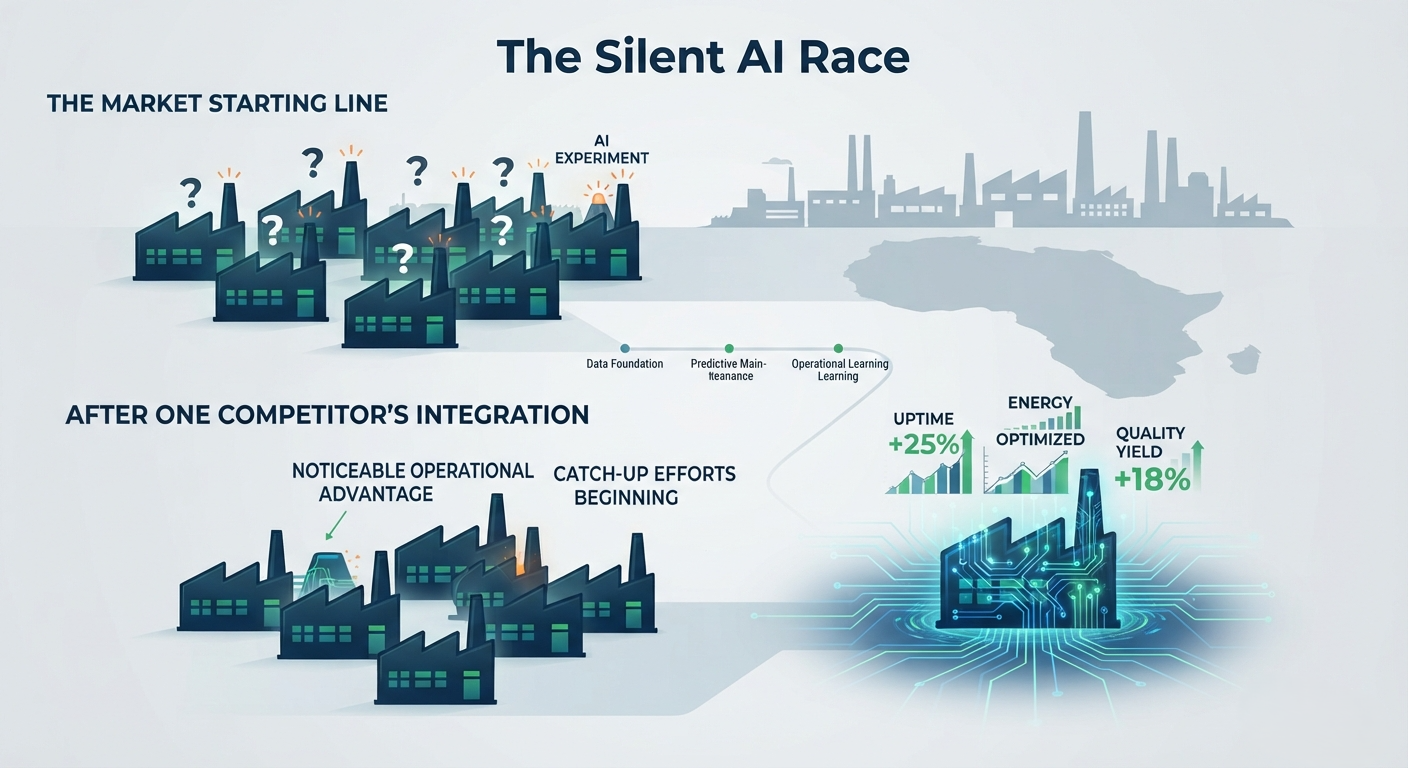
The First Competitor Changes Everything
Imagine ten manufacturers competing in the same market.
Nine are watching AI.
They're attending conferences.
They're reading reports.
They're discussing pilots.
They're waiting for the technology to mature.
One manufacturer decides to take a different approach.
Not:
"Let's buy an AI tool."
But:
"Let's identify where intelligence can materially improve our operation."
They begin with maintenance.
Then quality.
Then energy.
Then production.
Then operational knowledge.
They connect the required data.
They integrate AI into existing systems.
They measure the results.
And they keep learning.
At first, nobody notices.
Then the numbers start changing.
Less unplanned downtime.
Better asset utilization.
Faster fault diagnosis.
Less waste.
Better energy visibility.
Faster decision-making.
Better knowledge retention.
The competitor hasn't simply adopted AI.
They've started building operational intelligence.
Then the Question Changes
Before the first competitor moves, the question is:
"Do we really need AI?"
After the first competitor demonstrates results, the question becomes:
"How quickly can we catch up?"
That is a very different strategic position.
The early adopter gets to experiment.
The late adopter has to respond.
The early adopter can make mistakes while the stakes are relatively low.
The late adopter may be implementing under competitive pressure.
The early adopter develops internal capability.
The late adopter has to acquire it.
And perhaps most importantly:
The early adopter starts accumulating operational learning.
AI's Real Competitive Advantage Is Not the Model
This is one of the biggest misconceptions around industrial AI.
The competitive advantage isn't necessarily access to a particular AI model.
Models will continue to evolve.
The advantage comes from the infrastructure around them.
Consider two factories.
Factory A
Has:
Connected operational systems
Historical maintenance data
Production history
Quality data
Energy data
Digitized procedures
Experienced workforce knowledge captured digitally
Integrated operational data
Factory B
Has:
Spreadsheets
Disconnected systems
Manual reports
Fragmented maintenance records
Limited historical data
Knowledge held primarily by individuals
Both factories can access the same AI model.
But they cannot create the same intelligence.
AI is only as useful as the operational context surrounding it.
The Compounding Advantage
This is where things become interesting.
Suppose a manufacturer begins using AI for predictive maintenance.
The system starts learning from:
Equipment behavior
Failure patterns
Maintenance events
Operating conditions
Production context
Over time, the organization develops:
More data
↓
Better models
↓
Better predictions
↓
Better decisions
↓
Better operational outcomes
↓
More useful data
The cycle continues.
This means early adoption isn't simply about getting an AI system first.
It is about starting the learning cycle first.
It Only Takes One Competitor
This is the central argument.
Manufacturing does not need every company to adopt AI for the competitive landscape to change.
It only takes one serious competitor.
One company that decides to use AI to:
Reduce downtime
Improve maintenance
Optimize energy
Improve quality
Increase throughput
Reduce waste
Improve production planning
Capture operational knowledge
Accelerate engineering decisions
Once the results become visible, everyone else starts paying attention.
And then AI stops being a differentiator.
It becomes a requirement.
We've Seen This Pattern Before
This is not unique to AI.
Technology often follows a familiar path.
Stage 1 — Curiosity
"What is this?"
Stage 2 — Experimentation
"Can we use it?"
Stage 3 — Early Adoption
"Can it produce measurable value?"
Stage 4 — Competitive Adoption
"Our competitors are using it."
Stage 5 — Normalization
"Of course we have it."
Stage 6 — Competitive Necessity
"How do we operate without it?"
The strategic advantage is often greatest somewhere between Stage 2 and Stage 4.
That is where the market may be now.
But Deep AI Integration Is Not Without Risk
The argument for early adoption should not become an argument for reckless adoption.
Industrial AI introduces real risks.
Data quality
Poor data can produce poor intelligence.
Cybersecurity
Connecting operational environments creates additional security considerations.
Intellectual property
Industrial data can contain valuable proprietary knowledge.
Incorrect recommendations
AI systems can produce inaccurate or misleading outputs.
Workforce resistance
People may fear that AI is being introduced to replace them.
Legacy infrastructure
Existing systems may be difficult to connect.
Vendor dependency
Manufacturers could create another layer of technology lock-in.
ROI uncertainty
Not every AI project deserves investment.
These risks are reasons to build carefully.
They are not necessarily reasons to wait indefinitely.
The Better Strategy: Start Small, Build for Scale
Manufacturers do not need to transform the entire factory on day one.
Start with a problem where the economics are measurable.
For example:
Problem
Unplanned motor failures.
Existing state
Reactive maintenance.
Available data
Motor current, temperature, vibration, operating state and maintenance history.
AI application
Anomaly detection and failure prediction.
Operational decision
Intervene before failure.
Business metric
Downtime avoided.
That is a real AI use case.
Not an AI demonstration.
Build the Foundation Before Scaling the Intelligence
A successful industrial AI program requires more than models.
It requires:
Connected systems
→ Data can move.
Operational data
→ Information is accessible and contextualized.
Governance
→ Data access is controlled.
Infrastructure
→ AI applications can operate reliably.
Workforce capability
→ People understand and trust the systems.
Integration
→ AI can participate in operational workflows.
Measurement
→ Business value can be demonstrated.
This is why AI readiness is fundamentally an operational maturity question.
The Long-Term Investment Case
The strongest argument for starting early isn't simply today's ROI.
It is what the organization builds along the way.
A manufacturer that develops:
Data infrastructure
Integration capability
AI skills
Digital operational knowledge
Governance
Connected assets
Analytical capability
has created a foundation that can support many future applications.
Today:
Predictive Maintenance
Tomorrow:
Energy Intelligence
Then:
Production Optimization
Then:
Quality Intelligence
Then:
Industrial AI Copilots
Then:
Intelligent Decision Support
The individual applications may change.
The underlying capability remains.
What If You Wait?
Waiting has benefits.
You can observe what others do.
You can avoid early mistakes.
You can wait for technology to mature.
But waiting also has a cost.
If another manufacturer starts first, they may accumulate:
Data
Experience
AI talent
Integration expertise
Operational knowledge
Process improvements
Internal confidence
By the time everyone else starts, that organization may already have years of learning.
And learning cannot simply be purchased from a vendor.
The Nigerian Question
The question for Nigerian manufacturers should therefore not be:
"Is AI mature enough?"
AI will continue to change.
The better questions are:
Where are we losing operational value today?
Could intelligence help us recover some of it?
What data would we need?
Are our systems connected enough?
What knowledge should AI have access to?
What must remain protected?
What would happen if a competitor solved this problem before we did?
That final question is uncomfortable.
But it may be the most strategically important.
The Race May Be Quiet
Today, the manufacturing AI race may not look like a race.
There are no starting guns.
There are no obvious leaderboards.
Most companies are still evaluating.
But competitive races rarely become obvious at the beginning.
The first company doesn't necessarily announce:
"We are now entering the AI race."
It simply starts solving problems.
Then another company notices.
Then another.
And eventually everyone is moving.
By then, the question is no longer whether AI will matter.
The question is who learned how to use it first.
PlantAI Perspective
We don't believe every manufacturer needs to deploy AI everywhere.
We believe every serious manufacturer should understand where AI could materially change the economics of its operation.
That starts with assessing:
Systems Integration
Can your systems communicate?
Operational Visibility
Can you see what is happening?
Maintenance & Reliability
Can you predict what is about to fail?
Workforce Intelligence
Can your organization preserve and use operational knowledge?
Operational Excellence
Are your processes measurable and continuously improving?
Data Foundation
Is your operational data usable?
Automation & Decision Support
Can intelligence become part of operational workflows?
AI Readiness
Can your operation actually support Industrial AI?
The objective isn't to chase AI.
It is to build an operation that is ready to use intelligence when the right opportunity appears.
Discover your operational intelligence maturity.
Take PlantAI's assessment to benchmark your organisation and receive a personalised transformation roadmap.