Manufacturers Don't Have an AI Problem. They Have an Operational Intelligence Problem.
Across Africa and many emerging industrial markets, organizations are rushing to adopt Artificial Intelligence. Yet most are overlooking the real challenge: fragmented operations, disconnected systems, and poor visibility. Before AI can create value, businesses must first build an Operational Intelligence foundation.
The Industrial AI Conversation Is Missing an Important Question
Every conference, webinar, and technology vendor seems to ask the same question:
"How can AI improve manufacturing?"
A more important question is often ignored:
Is your operation actually ready for AI?
Many organizations invest in AI pilots expecting immediate operational improvements. Instead, they encounter inconsistent data, disconnected systems, and limited visibility into day-to-day operations.
The result is not an AI failure.
It is an infrastructure problem.
The Reality Inside Many Manufacturing Plants
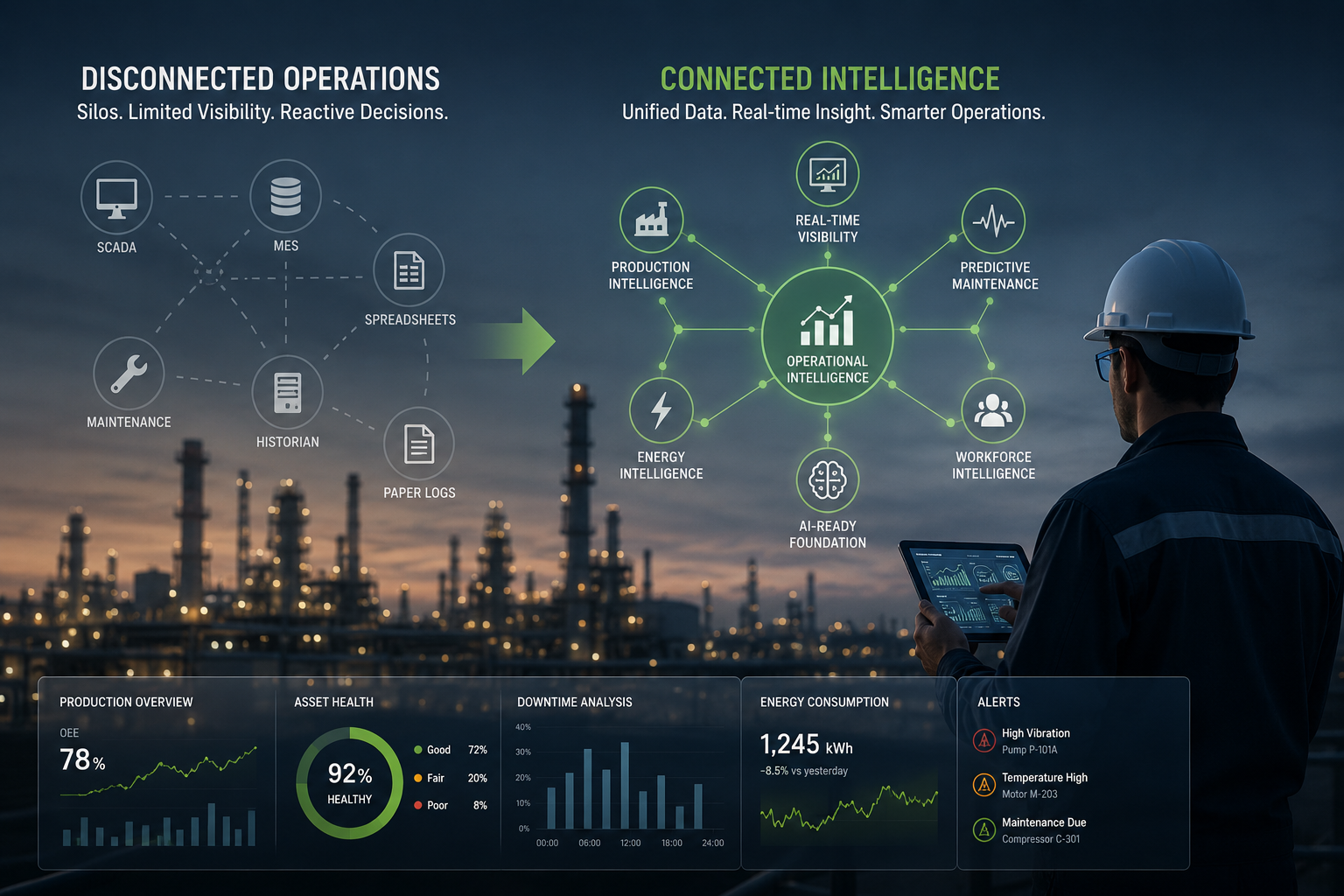
Many industrial facilities continue to rely on:
Spreadsheet-driven reporting
Manual production tracking
Isolated SCADA systems
Standalone maintenance software
Vendor-specific automation platforms
Paper-based operating procedures
Limited cross-department visibility
Each system performs its intended function, but together they create isolated pockets of information.
When production, maintenance, energy, quality, and enterprise systems cannot communicate effectively, decision-making becomes slower, more reactive, and heavily dependent on individual experience.
AI Can Only Learn From What It Can Access
Artificial Intelligence depends on accessible, reliable, and connected data.
If operational knowledge is scattered across different systems, AI cannot develop meaningful insights.
Instead of producing intelligent recommendations, organizations spend months collecting, cleaning, and reconciling operational data.
The technology is not the bottleneck.
The operational architecture is.
Operational Intelligence Creates the Foundation
Operational Intelligence connects systems, people, and processes into a unified operational environment.
Rather than introducing another isolated application, it creates continuous visibility across the business.
An effective Operational Intelligence platform enables organizations to:
Connect industrial and enterprise systems
Consolidate operational data
Monitor production in real time
Analyse maintenance performance
Track energy consumption
Standardise operational knowledge
Support data-driven decision making
Build AI-ready infrastructure
This foundation enables AI initiatives to generate measurable business outcomes instead of isolated experiments.
Moving Beyond Digitalization
Many organizations describe themselves as "digitally transformed" because they have implemented ERP systems, SCADA platforms, or cloud software.
Digitalization alone does not create intelligence.
Operational Intelligence goes further by integrating these technologies into a connected ecosystem where information flows continuously across departments and decision-makers.
The difference is significant.
Digitization creates data.
Operational Intelligence creates decisions.
A Practical Maturity Journey
Rather than pursuing AI as a standalone initiative, organizations should progress through a structured maturity model.
Stage 1 – Reactive Operations
Operations rely heavily on manual processes, spreadsheets, and individual knowledge.
Stage 2 – Digitising Operations
Core business processes become digital, but information remains fragmented.
Stage 3 – Connected Operations
Industrial and enterprise systems begin sharing operational data through secure integrations.
Stage 4 – Operational Intelligence
Real-time visibility, analytics, and performance monitoring become part of everyday operations.
Stage 5 – AI-Ready Enterprise
Connected operational data enables predictive maintenance, intelligent automation, AI copilots, and advanced operational optimization.
Building an AI-Ready Organization
Preparing for Industrial AI is not simply a technology project.
It requires organizations to strengthen the operational foundations that support intelligent decision-making.
Key priorities include:
Integrating operational systems
Eliminating data silos
Improving operational visibility
Establishing reliable data governance
Standardising operational knowledge
Building scalable data infrastructure
Developing workforce capabilities
Reducing vendor lock-in through open architectures
These investments create long-term operational resilience while positioning the organization for future AI adoption.
How PlantAI Helps
At PlantAI Ops & Automation, we believe organizations already possess valuable operational intelligence.
The challenge is rarely a lack of technology.
The challenge is unlocking and connecting the information that already exists across industrial operations.
Our approach focuses on:
Industrial Systems Integration
Operational Intelligence Platforms
Operational Data Architecture
Predictive Maintenance
Industrial AI Copilots
Energy Intelligence
AI Readiness Assessments
By building connected operational ecosystems, organizations gain the visibility, interoperability, and data foundation required to realize the full value of Industrial AI.
Discover Your Operational Intelligence Maturity
Most manufacturers don't have an AI problem.
They have a visibility, integration, workforce, and operational intelligence problem.
Take PlantAI's Operational Intelligence Maturity Assessment to evaluate your organization's current state, identify operational bottlenecks, and receive a personalized transformation roadmap.
Button: Start Free Assessment
Discover your operational intelligence maturity.
Take PlantAI's assessment to benchmark your organisation and receive a personalised transformation roadmap.