What AI-Ready Operations Actually Look Like
The five architectural traits shared by industrial organizations succeeding with AI.
What AI-Ready Operations Actually Look Like
There is a strange way companies talk about becoming AI-ready.
They talk about models.
They talk about copilots.
They talk about platforms.
They talk about AI talent.
And increasingly, they talk about how quickly they can deploy their first AI use case.
But walk into an operation where AI is actually producing sustained value and something else becomes obvious.
The interesting part isn't the AI.
It's everything underneath it.
The sensors are connected.
The systems can exchange information.
Operational data has context.
People know where information comes from.
Historical knowledge hasn't disappeared into someone's inbox.
And when an AI system makes a recommendation, there is a pathway for that recommendation to reach the person or process that needs it.
That is what AI readiness looks like in practice.
Not a chatbot.
Not an AI strategy document.
An operation that is structurally capable of using intelligence.
01 — The Operation Can Communicate With Itself
An AI system cannot create much value from an operation whose systems cannot communicate.
A factory may have:
PLCs
SCADA
MES
ERP
CMMS
Quality systems
Energy monitoring
Historians
and still have very little operational intelligence.
Why?
Because each system may know something different.
The production system knows what was produced.
The maintenance system knows what failed.
The energy system knows what was consumed.
The quality system knows what went wrong.
The historian knows what the machines were doing.
But if these systems exist as islands, the organization has information without context.
AI-ready operations begin creating relationships between those islands.
A failure isn't simply a maintenance event.
It becomes connected to:
what the machine was doing → what was being produced → what the energy conditions were → what changed → what happened previously.
That context is where intelligence starts becoming useful.
02 — Data Has Meaning
Having millions of data points doesn't make an operation intelligent.
A temperature reading without context is just a number.
Which asset?
Which component?
Which operating state?
Which production batch?
What was the normal range?
What happened before?
What happened afterwards?
AI-ready operations therefore don't simply collect data.
They contextualize it.
The difference is significant.
A data point says:
Motor temperature: 87°C.
Operational intelligence asks:
Is 87°C unusual for this motor under this load, at this production rate, at this ambient temperature, compared with its historical behaviour?
The second question is much closer to the problem the business actually cares about.
03 — Operational Knowledge Is Not Trapped in People's Heads
One of the least visible assets in manufacturing is experience.
Someone knows that a particular vibration pattern usually precedes a failure.
Someone knows that a particular machine behaves differently after a changeover.
Someone knows which alarm combinations actually matter.
Someone remembers the modification made seven years ago.
That knowledge can be extraordinarily valuable.
It can also walk out of the plant when the person who carries it leaves.
AI-ready operations begin turning this knowledge into something the organization can preserve, search, connect and use.
Maintenance records.
SOPs.
Engineering documentation.
Failure histories.
Shift reports.
Troubleshooting procedures.
Equipment manuals.
Lessons learned.
The objective isn't to replace the expert.
It is to make the expert's knowledge available beyond the expert's memory.
04 — Intelligence Has Somewhere to Go
A prediction that never reaches an operational workflow isn't much of a transformation.
Imagine an AI system identifies a high probability of equipment failure.
What happens next?
Does a maintenance planner receive an actionable alert?
Does a work order get created?
Does the engineer see the evidence behind the prediction?
Can the operator understand the recommended action?
Can the intervention be recorded?
Can the outcome feed back into the system?
AI becomes considerably more valuable when intelligence is connected to action.
The architecture therefore needs a path:
Data → Intelligence → Decision → Action → Feedback
That feedback is important.
Because an AI-ready operation doesn't simply consume predictions.
It learns from what happened afterwards.
05 — The Architecture Can Evolve
The final characteristic is perhaps the most important.
AI-ready doesn't mean:
"We have selected our AI vendor."
It means the organization has built an environment capable of evolving.
Today's model won't necessarily be tomorrow's model.
Today's use case won't necessarily be tomorrow's priority.
The architecture should therefore avoid making the organization dependent on a single application, model or vendor wherever practical.
A manufacturer might begin with predictive maintenance.
Later it may add:
Energy intelligence
Quality analytics
Production optimization
Knowledge copilots
Planning intelligence
The underlying operational architecture should support that evolution.
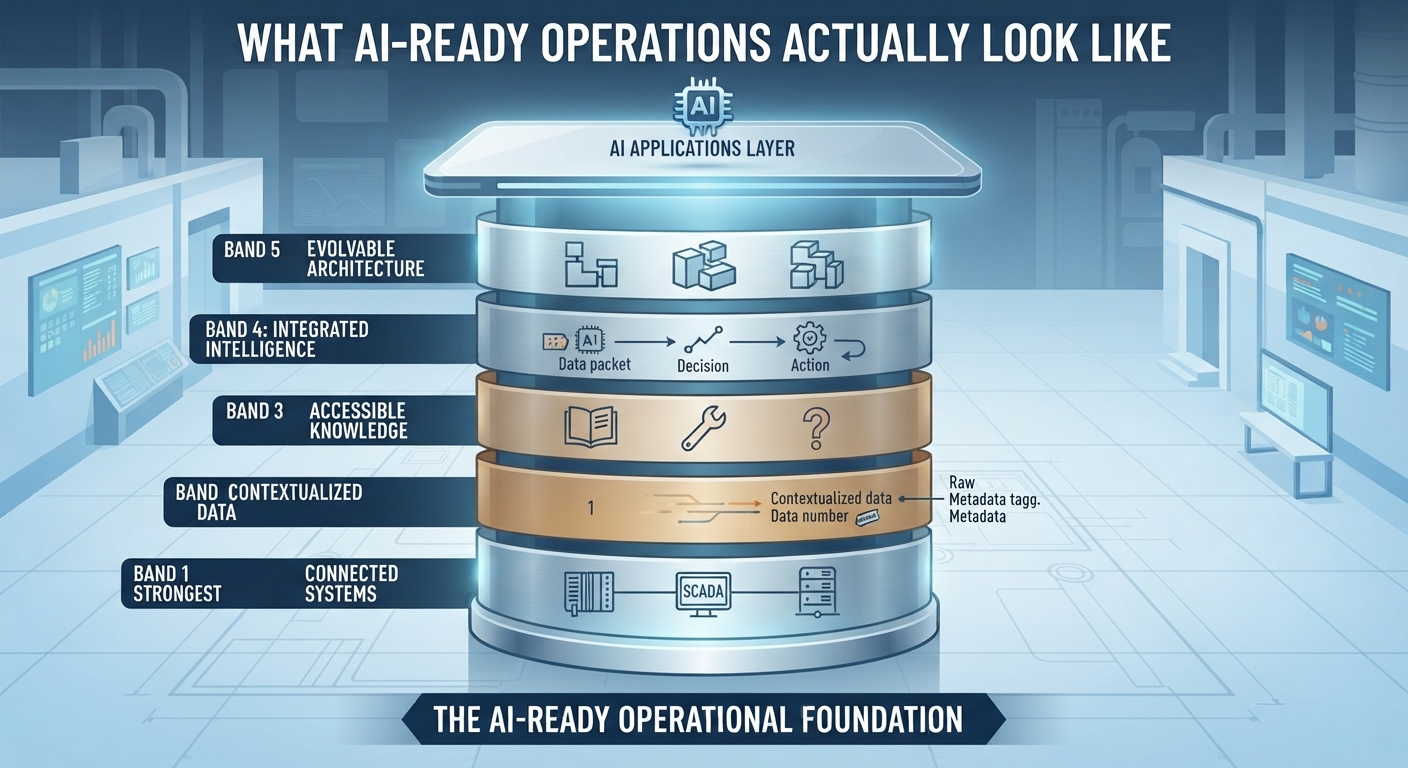
AI Readiness Is an Architecture
This changes the conversation.
The question isn't:
"Do we have AI?"
It's:
"Can our operation make useful intelligence possible?"
That is a much harder question.
And a much more useful one.
Because an AI-ready operation isn't defined by the number of AI tools it has purchased.
It is defined by the quality of the environment those tools enter.
Connected systems.
Contextualized data.
Accessible knowledge.
Integrated workflows.
Evolvable architecture.
These are the foundations.
AI sits on top.
The Five Traits at a Glance
Connected Systems
Operational systems can exchange relevant information.
Contextualized Data
Data has enough meaning to support useful analysis.
Accessible Knowledge
Institutional and operational knowledge can be found and used.
Integrated Intelligence
AI outputs can influence real operational workflows.
Evolvable Architecture
The operation can adopt new technologies without starting again.
PlantAI Perspective
We see AI readiness as an operational maturity problem before we see it as an AI procurement problem.
Before asking which model to deploy, manufacturers should understand whether their systems, data, processes and people can actually support one.
That is why the journey often begins much earlier than the AI project itself.
Build the conditions for intelligence. Then deploy intelligence where it matters.
Discover your operational intelligence maturity.
Take PlantAI's assessment to benchmark your organisation and receive a personalised transformation roadmap.